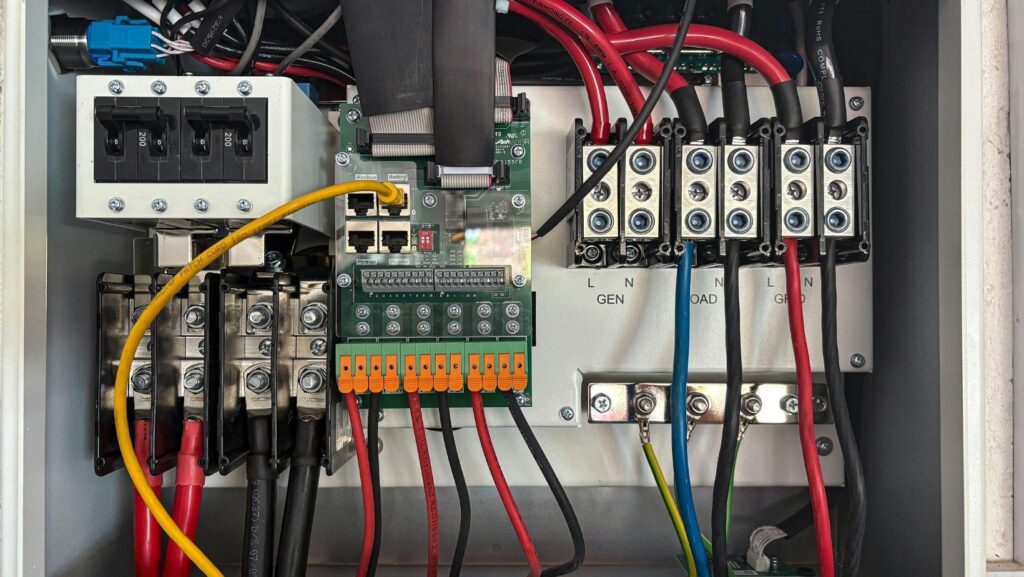
Routers, wi-fi access points, biometric scanners, electronic door locks, keypad entry systems, and many other similar devices have become an inseparable part of business life. All of them are powered by cables that carry both information signals and power, or, in other words, by the low-voltage infrastructure.
Often hidden behind walls, ceilings, and equipment racks, low-voltage infrastructure serves as the backbone to all of this.
In this article, we shall discuss why and how businesses depend on low-voltage infrastructure, and offer tips for properly building connectivity in your office.
What Is Low-Voltage Wiring?
Low-voltage wiring refers to cabling systems that carry data, communication signals, audio, video, and control information using significantly lower electrical voltages than standard building power systems – at 50 V or less.
While electrical wiring delivers power to lighting, HVAC equipment, and office appliances, low-voltage wiring is primarily designed to connect devices that consume less power and enable communication between them. Therefore, in low-voltage devices, electricity is used to deliver both power and information.
For these systems to operate, no additional electrical power is required. Yet, they support the flow of information throughout a facility.
Yet there are differences in the types of data the cables must carry. Their designs and builds vary accordingly. For example, there are the following types of cables:
Twisted Pair (Cat5e, Cat6, Cat6a): these are the standard for Ethernet networks, internet routers, and local area networks (LAN).
Coaxial Cables: they are used to transmit radio frequencies. Most often used in cable television (CATV) and internet connections.
Speaker Wire & Audio Cables: These cables are typically made of bare copper, which is well-suited to carry audio signals from amplifiers to speakers.
Security & Alarm Wire: solid or stranded multi-conductor wires used to connect door contacts, motion sensors, and fire alarms to central panels.
Landscape Lighting Cable: thicker, weather-resistant low-voltage wire (usually 12V or 24V) utilized to power outdoor pathway and garden lighting safely.
While the types of cables determine the data they carry, their proper selection and the right architecture determine the effectiveness of your business operations and the security of your facilities.
If you need a consultation on the right low-voltage infrastructure architecture for your office, you can get all the necessary information by contacting the security systems integration company integration company Kelo Tech, one of the best in Boston.
Why Low-Voltage Wiring Is Critical for Business Operations
Now, let’s look at how low-voltage wiring actually influences business operations. Although employees rarely see the infrastructure behind these systems, its impact on the organization is very strong. It stands for reliable connectivity, improved security, operational efficiency, and the ability to scale. Here’s more detail on this:
- Reliable Connectivity
In the era of digitalization and AI integration into business processes, business operations increasingly rely on uninterrupted connectivity. It stands behind everything: cloud applications, video conferencing, file sharing, and collaboration tools. If you design low-voltage infrastructure poorly, you get slow performance, network interruptions, and reduced productivity.
- Improved Security
Security systems of today rely completely on low-voltage networks. They include access control systems, surveillance cameras, alarms, and visitor management platforms, all of which require stable communication pathways.
When low-voltage infrastructure is properly designed, these systems can work more effectively together to provide stronger protection for people, assets, and information.
- Enhanced Operational Efficiency
Low-voltage systems power the tools that automate many of the processes that were once done manually. They support automated visitor management, remote access control administration, occupancy monitoring, building automation, integrated security management, and more. With these capabilities, businesses operate more efficiently and reduce administrative workloads.
- Scalability for Future Growth
Modern businesses rarely remain static, so do the technology requirements. Businesses grow, and often need additional workstations, security devices, wireless coverage, and connected technologies. A well-planned low-voltage infrastructure allows organizations to grow without major rewiring. A poorly designed one incurs extra costs. Therefore, it makes sense to think through the low-voltage architecture thoroughly from the start, to avoid issues in the future.
Tips for The Proper Architecture of Low-Voltage Connections
If you need to be sure that your low-voltage network is up all the time and works effectively, there are several things you can do to ensure this from the start:
Build around structured cabling – Before doing any job about installing the cables, design the structure. Do not install cables on an as-needed basis.
Plan for the future growth – think about what your office will look like in 10 years and build the system accordingly.
Separate low-voltage and electrical cabling – if you put them too close together, it may cause electrical interference.
Centralize network and security equipment – place switches, patch panels, controllers, and other equipment in dedicated network closets or equipment rooms.
Summing up
The proper architecture of the low-voltage infrastructure provides a solid foundation for your business’s future growth and will save you from many issues.