Companies are using AI voice agents to answer calls, handle support requests, and route customers without a human on the line. It works. According to KPMG, 88% of organizations are either exploring or piloting AI agents. Accenture reports that AI-powered virtual agents can handle a large share of routine customer interactions, helping reduce service-center costs and agent workloads.
The problem is picking the right platform. There are real differences between options: in speed, price, compliance, and how much you can actually control. This article breaks down the five best voice AI platforms for enterprise in 2026, with clear pros, cons, and who each one is right for.
What to Look for Before Choosing a Platform
Not every platform can handle enterprise workloads. Here are the things that actually matter:
- Response speed: The AI needs to respond in under 300ms. Anything slower and the conversation feels broken
- Who owns the network: Platforms that run their own infrastructure are faster and more reliable than those that rent from third parties
- Compliance certifications: You need HIPAA, SOC 2 Type II, GDPR, and PCI if you operate in healthcare, finance, or handle payment data
- Data residency: You should control where call recordings and transcripts are stored
- Pricing clarity: Per-minute pricing adds up fast at scale. Know the full cost before you commit
- How many calls can it handle at once? Volume spikes should not degrade call quality
- Developer tooling: Good APIs, clear docs, and webhook support cut integration time significantly
Top Voice AI Platforms 2026
|
Platform |
Best for |
Owns infrastructure |
Key compliance |
|
Telnyx |
High-volume, regulated industries |
Yes |
HIPAA, SOC 2, PCI, GDPR, ISO |
|
Twilio |
Teams already on Twilio |
No |
SOC 2, HIPAA (add-on) |
|
Amazon Connect |
AWS-native enterprises |
No (AWS infra) |
HIPAA, SOC 2, PCI |
|
Google CCAI |
Multilingual, existing CC platforms |
No (GCP infra) |
SOC 2, GDPR, HIPAA |
|
Vapi |
Fast prototyping, less regulated use cases |
No |
Limited |
1. Telnyx Voice AI
Telnyx is the top pick for enterprise in 2026. Unlike most voice AI platforms, Telnyx combines telephony, AI processing, and network infrastructure under one provider. The company operates its own global telecom network and supports AI voice agents, SIP trunking, and programmable voice services through a single platform.
Highlights
- Runs AI voice agents that answer, route, and resolve calls without human agents
- Supports custom conversation logic and escalation to live agents when needed
- Connects to CRMs and contact center tools via REST APIs and webhooks
- Handles SIP trunking natively with no separate carrier required
- Supports speech recognition, language models, and text-to-speech workflows within the same platform
Why it stands out:
- Operates its own telecom infrastructure, with licensed telecom operations in 40+ countries and PSTN connectivity in more than 100 countries, reducing reliance on third-party telephony providers
- Supports A-level STIR/SHAKEN attestation for eligible outbound US calls, helping enterprises improve call trust and answer rates
- Voice AI agents start at approximately $0.05 per minute, including speech-to-text, text-to-speech, and model inference
- Brings speech processing, model inference, telephony, and voice orchestration together under a single platform
- Supports enterprise compliance requirements with SOC 2 Type II, PCI DSS, ISO 27001, HIPAA-eligible services, and GDPR support
- Offers EU-based infrastructure options for organizations with data residency requirements
- Transparent usage-based pricing and native SIP trunking without requiring a separate carrier
- Detailed API documentation and developer-friendly tooling
Best for: Financial services, healthcare, logistics, and enterprise customer-service teams that need low latency, compliance coverage, and telecom infrastructure from a single provider.
2. Twilio Voice (with AI Extensions)
 The voice platform of Twilio is stable, well-documented, and used by enterprise teams. You can add AI capabilities using Twilio’s ConversationRelay feature, which connects real-time voice calls to LLMs like GPT or Claude.
Highlights
- Handles inbound and outbound calls via programmable APIs
- ConversationRelay streams live audio to an AI model and plays back responses
- Connects to a large library of third-party integrations and contact center tools
- Offers phone numbers in 100+ countries
What’s more
- Global carrier network and phone number inventory
- Developer documentation
- Familiar to most enterprise engineering teams
Best for: Teams already using Twilio that want to add AI to their existing voice setup without switching platforms.
3. Amazon Connect with Lex
 Amazon Connect is AWS’s cloud contact center product. Pair it with Amazon Lex (AWS’s conversational AI service), and you get an AI-powered voice system that lives entirely inside the AWS ecosystem.
Highlights
- Manages inbound and outbound call flows through a drag-and-drop contact flow builder
- Amazon Lex handles speech recognition and intent detection
- Integrates with Lambda, S3, DynamoDB, Kinesis, and other AWS services
- Feeds call analytics into Amazon QuickSight or other BI tools
What’s more
- Native integration with all major AWS services
- HIPAA-eligible and covered by AWS’s compliance certifications
- Real-time and historical reporting
Best for: Enterprise teams already on AWS with dedicated cloud engineers who want voice AI inside their existing AWS environment.
4. Google Cloud Contact Center AI (CCAI)
 Google’s Contact Center AI brings Dialogflow, Google’s speech-to-text, and natural language understanding into one platform. It’s designed to plug into existing contact center software rather than replace it.
Highlights
- Adds AI-powered virtual agents to existing contact center platforms
- Supports voice and chat across the same AI system
- Uses Google’s speech recognition
What’s more
- Supports multilingual deployments at scale
- Covered by Google Cloud’s compliance certifications
Best for: Global enterprises handling calls in multiple languages, or teams that want to add AI to an existing Genesys, Cisco, or Avaya system.
5. Vapi
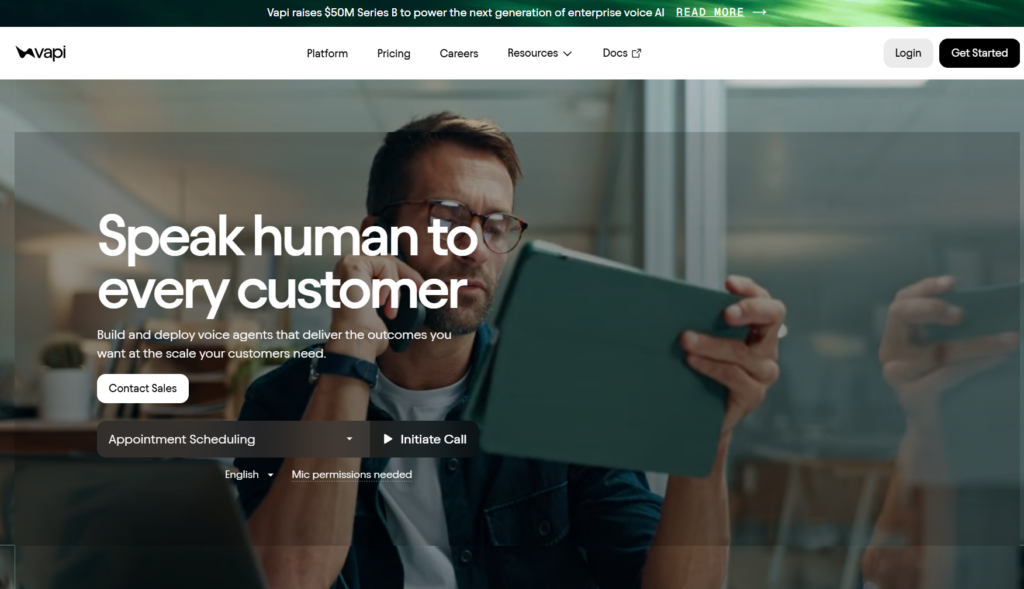 Vapi provides an API-based platform for building voice AI agents, handling telephony, speech processing, and LLM routing through a unified interface.
Highlights
- Deploys inbound and outbound AI phone agents via API
- Supports LLM (GPT-4, Claude, Gemini, etc.) and any voice provider
- Handles call routing, interruptions, and function calling mid-conversation
- Works with phone numbers from Twilio, Vonage, or your own SIP trunk
What’s more
- Flexible: swap models, voices, or transcription providers without rebuilding
- REST API with solid documentation
- Active developer community with fast product iteration
Best for: Engineering teams that need to move fast and build in verticals where compliance requirements are less strict.
Which Platform Should You Choose?
There’s no single best voice AI platform for enterprise. The right one depends on your compliance requirements, how much of the infrastructure you want to own versus rent, and how predictable you need your costs to be.
Before committing to any platform, consider these things:
- What’s bundled into the per-minute rate versus billed separately: speech-to-text, text-to-speech, and LLM tokens are sometimes included, sometimes metered on top, and that gap can significantly change your real cost at scale.
- Which compliance certifications are already built in versus require extra configuration: this matters most if you’re in healthcare, finance, or anywhere handling regulated data.
If carrier-owned infrastructure and built-in compliance coverage are priorities for your use case, Telnyx is worth evaluating alongside the other options here.