Passwords were once the main way to protect digital accounts. Today, they have become one of the biggest security risks. Many users reuse passwords, forget them, or accidentally share them through phishing attacks. This creates problems for both individuals and businesses.
Biometric technology is changing the way people verify their identity. Instead of using a password or PIN, users can prove who they are with personal features. These features include fingerprints, facial patterns, voice, eye scans, and behavior patterns.
For businesses, biometric authentication is becoming an important part of modern security. It helps prevent fraud, improves user experience, and supports passwordless access across devices, applications, and online services.
What is biometric authentication?
Biometric authentication is a method of verifying identity through unique human characteristics. Unlike passwords, biometric features belong to the user and are much harder to copy or share.
Common biometric methods include:
- Fingerprint recognition.
- Facial recognition.
- Iris scanning.
- Voice recognition.
- Behavioral biometrics, such as typing patterns and movement.
Organizations use biometric technology to protect accounts, secure customer services, control building access, and improve digital identity management.
Why biometrics are replacing passwords
Passwords create many security challenges. Users often create weak passwords or use the same password for several accounts. Cybercriminals can steal passwords through fake websites, malware, or data breaches.
Biometric authentication offers a simpler solution. Users do not need to remember complicated passwords. They can access systems through a quick identity check.
The main benefits of biometric authentication include:
- Better security: Personal features are harder to steal or guess.
- Faster access: Users can verify their identity within seconds.
- Lower fraud risk: Stolen passwords are less useful when biometric checks are required.
- Lower support costs: Companies receive fewer password reset requests.
- Passwordless access: Organizations can build modern authentication systems.
How biometric authentication works
Biometric systems use sensors, software, and artificial intelligence to check a person’s identity.
The process includes several simple steps.
Capturing biometric data
First, the system collects biometric information.
A fingerprint scanner records fingerprint detail. Facial recognition systems analyze facial features. Voice systems study speech patterns.
Modern systems also use security features such as:
- High-quality sensors.
- Multiple data points.
- Automatic adjustments for different conditions.
- Liveness detection.
Liveness detection helps prevent attacks using photos, videos, or recorded voices.
Creating a secure template
After collecting biometric data, the system creates a digital template.
This template contains important information about the user’s biometric features. It does not usually store the original image or recording.
The system converts the data into a secure format that can be used for future comparisons.
This process helps protect sensitive biometric information while allowing fast authentication.
Protecting biometric data
Biometric information requires strong protection. A stolen password can be replaced, but a fingerprint or facial pattern cannot.
Companies protect biometric data with:
- Encryption.
- Secure storage.
- Access controls.
- Privacy policies.
Many modern devices store biometric information directly on the device. This reduces the need to send sensitive data to external systems.
Matching and verification
When a user tries to log in, the system captures new biometric data. It then compares this information with the stored template.
The system checks whether the new sample is close enough to the original data. If the match is successful, access is approved.
If the system detects a problem, access can be blocked or additional verification can be required.
Types of biometric authentication
Biometric authentication comes in several forms, each using unique physical or behavioral traits to verify identity. Here are the most common types:
Physiological Biometrics
Physiological biometrics are based on physical features:
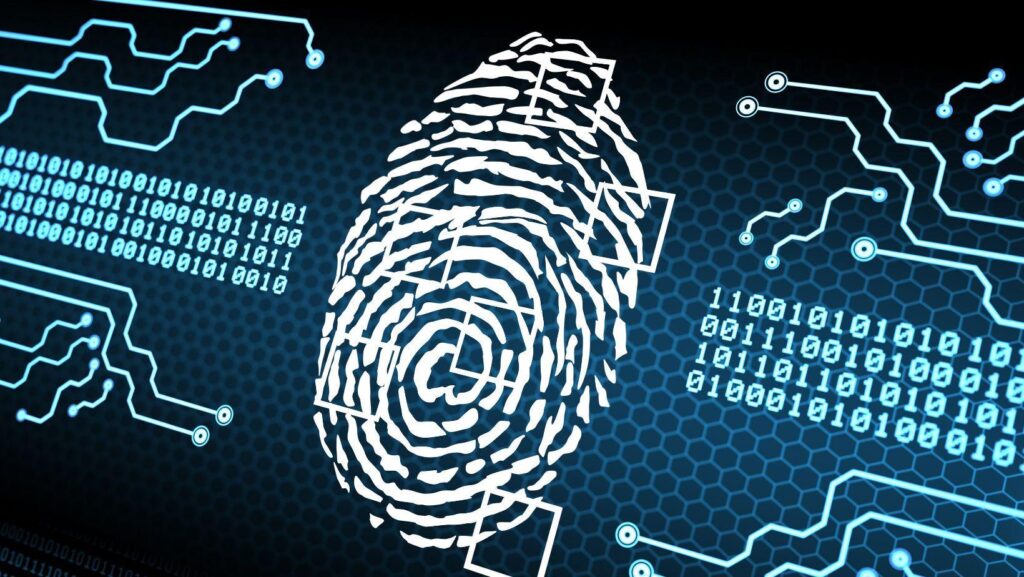
- Fingerprint recognition is one of the most common methods. It checks unique fingerprint patterns and can detect fake samples.
- Facial recognition uses artificial intelligence to identify people through facial features. Modern systems can use advanced cameras and sensors to improve accuracy.
- Iris recognition checks patterns in the eye. It provides accurate identity verification because each person’s iris pattern is different.
- Palm vein recognition uses infrared technology to identify patterns under the skin. It is often used in workplaces and secure facilities.
Behavioral biometrics
Behavioral biometrics focus on how people act and interact with technology.
Examples include:
- Voice recognition: Checks speaking style, tone, and pronunciation.
- Typing behavior: Measures typing speed and rhythm.
- Movement analysis: Studies walking patterns and device usage.
These methods can provide continuous authentication without interrupting the user.
Why companies use multimodal biometrics
Many organizations combine different biometric methods to improve security.
For example, a system may use facial recognition together with voice verification. Another system may combine fingerprints with behavior analysis.
Using multiple factors makes attacks much harder. If one method fails, another method can help identify suspicious activity.
Multimodal biometrics are especially useful in finance, healthcare, government, and enterprise security.
Real-world applications
Biometric authentication is already used in many industries.
Banks use biometrics to verify customers and protect digital payments. Healthcare organizations use them to protect patient information. Companies use biometric systems for employee access, device protection, and workplace security.
Consumers use biometric technology every day through smartphones, laptops, payment systems, and online services.
Digital entertainment platforms also face similar security challenges. For example, services powered by an online casino games API require reliable user verification and fraud prevention. Biometric authentication can help these platforms reduce unauthorized access, prevent account sharing, and improve trust between users and operators.
As cloud platforms, remote work, and digital services continue to grow, secure identity verification is becoming more important.
The future of authentication
Biometric technology is changing the future of digital security. It allows people to access services without relying only on passwords.
However, organizations must use biometric systems responsibly. They need strong data protection, clear privacy rules, and secure storage methods.
Biometric authentication is not only a replacement for passwords. It represents a new approach to digital identity. By combining security and convenience, biometrics are helping create safer and easier digital experiences.