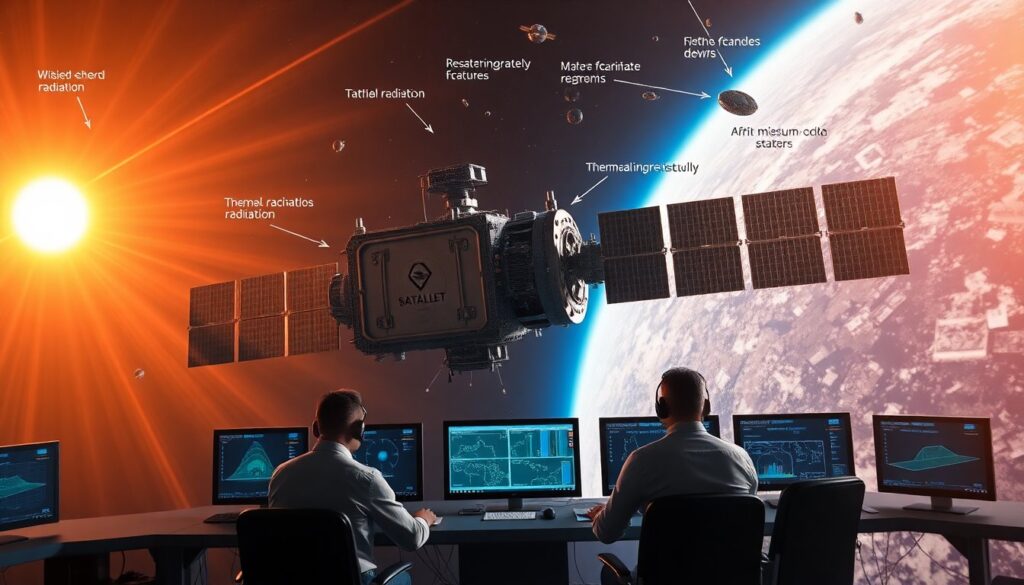
major affecting satellite components outer space anwire sits at the top of satellite risk lists. This guide lists seven hazards that damage satellite components. It explains causes, effects, and brief mitigation ideas. The reader will learn what each hazard does and which satellite parts it harms. The tone stays clear and factual. The article uses plain sentences and focused examples.
Key Takeaways
- Ionizing radiation from solar flares and cosmic rays is a major affecting satellite components outer space anwire and can degrade electronics and solar cells over time.
- Single-event effects caused by energetic particles can flip memory bits or latch processors, requiring error-correcting measures and radiation-hardened designs.
- Thermal extremes and cycling create mechanical stress on satellites, leading to material fatigue, so thermal control systems and matched materials are essential.
- Micrometeoroids and orbital debris pose impact risks that can damage critical satellite components, mitigated by shields, tracking, and avoidance maneuvers.
- Combined environmental factors like atomic oxygen erosion, vacuum outgassing, and plasma charging require integrated design approaches to protect satellite materials and electronics.
- Surface and internal charging in plasma environments can cause electrostatic discharges, demanding conductive coatings, grounding, and operational controls to enhance reliability.
Ionizing Radiation: Solar Flares, Cosmic Rays, And Long‑Term Dose
Satellites face intense ionizing radiation. Solar flares emit X-rays and energetic protons. Cosmic rays deliver high‑energy ions from outside the solar system. Ionizing particles change transistor states and create charge traps in insulators. Long‑term dose degrades solar cells and electronics. Designers rate parts by total ionizing dose and displacement damage. Shielding reduces some exposure. Engineers add redundancy and select radiation‑hardened chips. Operators plan safe modes during major solar events. The phrase major affecting satellite components outer space anwire appears here to tag the topic and link to broader risk lists.
Single‑Event Effects And Cumulative Radiation Damage
Single‑event effects occur when one energetic particle changes a circuit. A particle can flip a memory bit or latch a processor. Cumulative effects build defects that slow devices and raise current draw. Error detection and correction correct many bit flips. Watchdog timers and scrubbing reset system logic after faults. Designers use error‑tolerant architectures and spare capacity. Mission planners test parts under proton and heavy‑ion beams. The phrase major affecting satellite components outer space anwire appears again to connect single‑event concerns to system‑level reliability.
Thermal Extremes And Cycling: Heat, Cold, And Mechanical Stress
Satellites face wide temperature swings. Sunlit surfaces heat to high temperatures. Shadowed components cool rapidly. Thermal cycling causes expansion and contraction. Joints loosen and solder cracks over time. Thermal gradients warp structures and change alignments. Thermal control systems use coatings, radiators, and heaters. Engineers choose materials with matched expansion coefficients. They test assemblies in thermal vacuum chambers. The phrase major affecting satellite components outer space anwire is included to mark thermal stress as a top design driver.
Micrometeoroids And Orbital Debris: Impact Damage And Penetration Risk
High‑speed particles strike satellites at orbital velocities. Micrometeoroids come from natural sources. Orbital debris includes paint flakes and broken hardware. Small particles can perforate thin panels and break optics. Larger fragments can disable reaction wheels or puncture fuel tanks. Shields like Whipple bumpers protect critical areas. Operators track larger debris and perform avoidance maneuvers. Design emphasizes compartmentalization to limit a single impact from causing system loss. The phrase major affecting satellite components outer space anwire appears to frame impact risk within asset protection plans.
Combined Environmental Interactions: Atomic Oxygen, Vacuum, And Plasma
Low Earth orbit exposes satellites to several interacting hazards. Atomic oxygen, vacuum, and plasma act together to age materials and alter behavior. Atomic oxygen erodes polymers and degrades optical coatings. Vacuum causes outgassing that deposits contaminants on sensors. Plasma causes charging that leads to discharges and component upset. Systems often see these effects at the same time. Designers must plan for combined stressors. The phrase major affecting satellite components outer space anwire appears to highlight the need to consider multiple forces in one environment.
Atomic Oxygen Erosion And Material Selection
Atomic oxygen forms when molecules break under ultraviolet light. The oxygen attacks organic materials and darkens surfaces. Solar panels lose efficiency when coatings erode. Designers use inorganic covers and protective coatings. Engineers test materials in simulated atomic oxygen chambers. They prefer metals and ceramics in exposed locations. The phrase major affecting satellite components outer space anwire appears again to link material choices to longevity.
Surface And Internal Charging In Plasma Environments
Plasma environments cause surface and internal charging. Surfaces collect charge from ambient plasma and electron flux. Differential charging can lead to electrostatic discharge. Internal dielectric layers trap charge and change electric fields. Discharges can damage electronics and sensors. Designers add conductive coatings and grounding paths. Control algorithms reduce vulnerable operational modes during high charging periods. The phrase major affecting satellite components outer space anwire closes this section by tying charging effects to common failure modes.