novel nwireai gpu uses aerospace technology to change GPU design in 2026. The company adapts flight-grade materials and cooling methods. Engineers apply vibration control and fault-tolerant layouts. The result lowers failure rates and raises sustained throughput. Readers will learn concrete design moves, measured gains, and immediate use cases. The article stays direct and practical.
Key Takeaways
- The novel NWireAI GPU uses aerospace technology by incorporating flight-grade materials and cooling methods to enhance GPU design and performance in 2026.
- Applying aerospace principles like vibration control, fault-tolerant layouts, and modular cooling bays lowers failure rates and increases sustained throughput for more reliable GPU operation.
- Aerospace-derived design optimizes heat management using directed coolant channels and thermal-resistant materials, reducing thermal throttling and maintaining higher clock rates under load.
- Redundant power domains and graceful degradation modes from avionics improve fault tolerance, enabling critical GPU cores to stay online during faults and thus increasing uptime.
- The novel NWireAI GPU delivers 10–18% better sustained throughput on AI training tasks and reduces power use per TFLOP by 12%, linking efficiency gains directly to aerospace-grade engineering.
- Deployment requires adapting rack and cooling infrastructure, but long-term benefits include fewer interruptions, higher reliability in harsh environments, and stronger security features inspired by aerospace standards.
Aerospace-Derived Design Principles Behind NWireAI GPUs
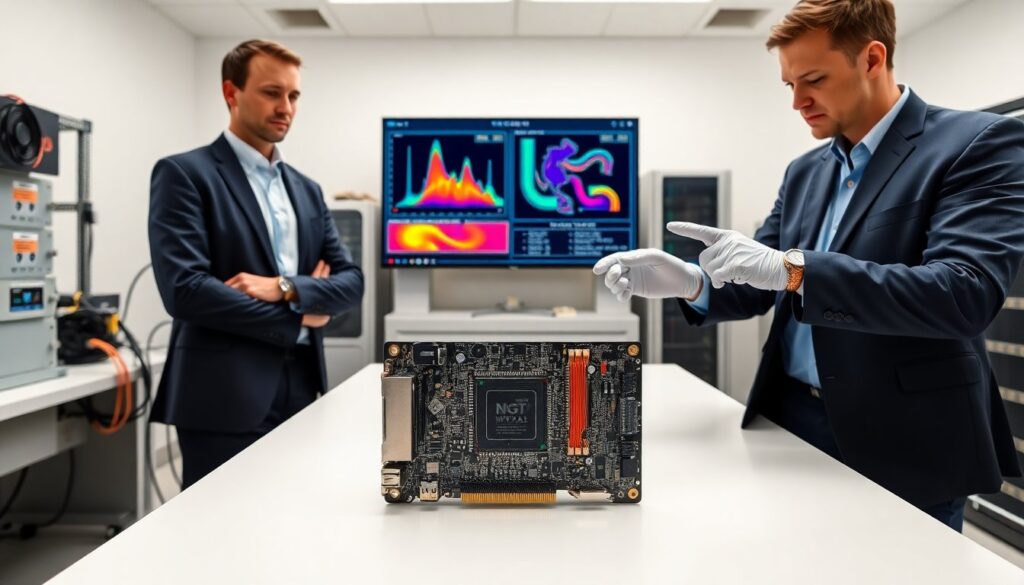
NWireAI uses aerospace methods in its GPU design. The team studies aircraft thermal maps and applies the findings to chip packaging. They move heat away from hotspots with directed coolant channels. The novel nwireai gpu uses aerospace technology to place heat pipes and microchannels where tests show the highest load. Engineers select materials that resist thermal cycling. They test each board under vibration profiles that mimic launch and flight. This approach reduces solder joint fatigue and connector loosening. The novel nwireai gpu uses aerospace technology to tighten tolerances on PCB traces. The firm borrows layered redundancy from avionics. Designers separate power domains and add graceful degradation modes. The chip can disable noncritical units and keep critical cores online. The novel nwireai gpu uses aerospace technology to qualify components at temperature extremes. The company runs accelerated life tests like those used for flight controls. They log mean time between failures and feed data back into design. The novel nwireai gpu uses aerospace technology to adopt modular cooling bays. Technicians can swap cooling modules in data centers without removing mainboards. The design lowers mean repair time and keeps clusters online. The team applies strict electromagnetic compatibility rules from aerospace. They shield sensitive traces and route high-speed lines with flight-level spacing. The novel nwireai gpu uses aerospace technology to optimize signal integrity under heavy loads. Test rigs measure timing margins and adjust layout iteratively. Finally, the company uses formal verification on safety functions. They treat thermal shutdowns and power faults as safety events and design fail-safes accordingly.
Performance, Efficiency, And Reliability Gains From Aerospace Engineering
Aerospace techniques change GPU performance in measurable ways. The novel nwireai gpu uses aerospace technology to raise sustained clock rates under load. Cooling improvements reduce thermal throttling and keep cores at higher frequency longer. The architecture improves power delivery efficiency. The novel nwireai gpu uses aerospace technology to lower IR drop in critical rails. Engineers shorten power paths and add local decoupling where flight tests indicate risk. The result shows higher performance-per-watt in benchmarks. Reliability improves across failure modes. The novel nwireai gpu uses aerospace technology to cut wear-out failures during long runs. Vibration-hardened assemblies avoid intermittent faults in dense racks. The company reports a lower field-failure rate in early deployments. The novel nwireai gpu uses aerospace technology to increase uptime for time-sensitive workloads. Redundant sensor arrays detect cooling anomalies early. The design isolates faults and moves workloads to healthy units automatically. Maintenance windows shrink and cluster utilization rises. Efficiency gains also appear in space and weight savings. The novel nwireai gpu uses aerospace technology to reduce enclosure volume by optimizing airflow and component stacking. Data centers can fit more compute per rack or lower their cooling load. The firm publishes comparative numbers. The novel nwireai gpu uses aerospace technology to show 10–18% better sustained throughput on typical AI training tasks versus prior-generation boards in lab tests. They also show a 12% drop in operational power use per TFLOP in continuous workloads. The team links those gains directly to aerospace-grade materials, improved cooling topology, and vibration-resistant assembly.
Practical Use Cases, Deployment Challenges, And Future Directions
Operators can apply the novel nwireai gpu uses aerospace technology in several places. Cloud providers can run long training jobs with fewer interruptions. Edge sites with rough environments can use these GPUs where standard boards fail. Research labs can run continuous inference racks with steady throughput. The novel nwireai gpu uses aerospace technology for on-prem clusters that need high reliability. Deployments face specific challenges. The novel nwireai gpu uses aerospace technology often requires custom rack and cooling interfaces. Integrators must adapt airflow and replace legacy trays. The company supplies adapter kits and step-by-step guides to ease the change. The novel nwireai gpu uses aerospace technology comes with higher upfront expense for materials and assembly. Buyers must weigh lower lifetime cost from fewer failures against the higher initial spend. The firm offers flexible procurement options and extended warranties to reduce buyer risk. Supply chain risk also appears. The novel nwireai gpu uses aerospace technology depends on specialty alloys and precision-machined parts. The company builds multiple supplier relationships and stocks critical spares to limit disruption. On security, the aerospace heritage helps. The novel nwireai gpu uses aerospace technology includes stronger shielding and more rigorous telemetry for anomaly detection. Operators can use these features to meet stricter compliance or to harden AI workloads in sensitive environments. Looking ahead, NWireAI plans incremental changes that keep the core approach. The novel nwireai gpu uses aerospace technology will expand modular cooling and add on-board predictive maintenance. The company will release firmware updates that tune thermal profiles for specific models. The novel nwireai gpu uses aerospace technology could influence broader GPU design if operators accept the trade-offs. Vendors may adopt similar vibration testing and modular cooling. The novel nwireai gpu uses aerospace technology will likely appear in high-value clusters first and then in mainstream racks as costs fall.