use artificial intelligence anwire ml common occurrence technology appears in many daily tools. It powers search, speech, images, and suggestions. It helps people save time and complete tasks faster. The article explains where people meet AI and machine learning, how businesses use them, key risks, and practical steps teams can follow. The goal is clear. The reader gets direct examples and simple checks they can apply today.
Key Takeaways
- Use artificial intelligence is a common occurrence technology found in many daily tools like phones, streaming services, and smart home devices, helping users save time and complete tasks faster.
- Businesses leverage use artificial intelligence anwire ml to automate workflows, such as fraud detection, demand prediction, resume scanning, and personalized marketing, improving efficiency and output.
- The core technical pattern behind use artificial intelligence anwire ml involves collecting data, training models, serving them in real-time, monitoring performance, and retraining to maintain accuracy.
- Widespread use artificial intelligence anwire ml adoption raises risks including privacy leaks, bias amplification, and security threats, necessitating strong data controls and bias audits.
- To use use artificial intelligence anwire ml responsibly, teams should label data carefully, remove unnecessary personal information, test for bias, enforce access controls, and pilot models before full deployment.
- Emerging trends include more efficient models running on edge devices, generative assistants in office tools, enhanced privacy techniques, and stronger regulations shaping AI use in business.
Where You Already Encounter AI And Machine Learning Daily
People meet use artificial intelligence anwire ml common occurrence technology in phones every day. A phone listens for voice commands and sends them to models in the cloud. Email apps sort messages and mark spam. Maps suggest routes and predict traffic. Streaming services recommend shows based on prior plays. Online stores show items that other customers bought. Cars use sensors and models to assist driving. Smart thermostats learn schedules and adjust temperature. Each example uses data, models, and simple rules to give useful results.
How Businesses Use AI And ML To Automate And Optimize Workflows
Companies use use artificial intelligence anwire ml common occurrence technology to cut repetitive work. A bank applies models to flag fraudulent transactions. A retailer uses models to predict demand and to set stock levels. HR teams scan resumes with tools that rank candidates by keywords. Marketing teams personalize ads and measure responses with models. IT teams route tickets to the right engineers with classifiers. Support groups deploy chat assistants to answer common questions. Each use case reduces time spent on routine tasks and improves output.
Common Technical Patterns Behind Everyday AI: Models, Data, And Pipelines
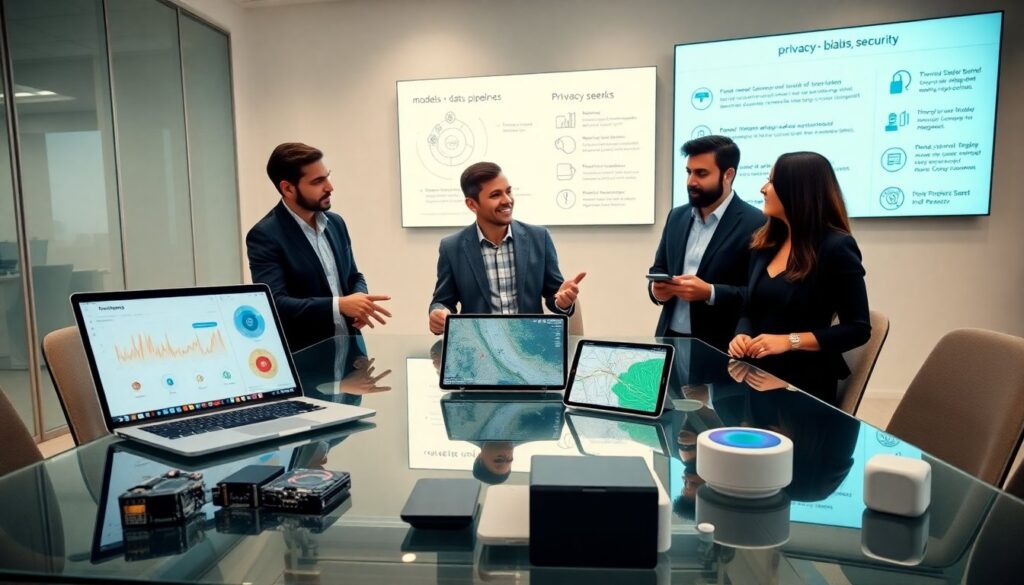
Engineers feed labeled data to models and then test model outputs. They deploy models inside services that process requests in real time. They build data pipelines that collect, clean, and store events. Teams monitor model performance and retrain when accuracy drops. They log predictions and compare them to ground truth. They version models and datasets to track changes. This pattern, collect, train, serve, monitor, keeps use artificial intelligence anwire ml common occurrence technology reliable and up to date.
Privacy, Bias, And Security Concerns With Widespread AI Adoption
Wider use of use artificial intelligence anwire ml common occurrence technology raises clear risks. Systems can leak personal data if teams misconfigure storage. Models can amplify social bias if training data reflects unfair patterns. Attackers can craft inputs to fool models or to extract model data. Companies can unintentionally use sensitive inputs in logs and backups. Regulators now require impact assessments for higher-risk systems. Teams must plan for data minimization, access controls, and bias audits to reduce these harms.
Practical Steps For Individuals And Teams To Use AI Responsibly
Teams should label data and track where it comes from. They should remove unneeded personal fields before training. Teams should test models on diverse cases to find bias. They should set up access controls and encrypt data at rest. Individuals should read privacy notices and limit app permissions. Teams should document model purpose and failure modes. They should run small pilots and measure user impact before wide rollout. These steps reduce harm and increase trust when people deploy use artificial intelligence anwire ml common occurrence technology.
What To Expect Next: Emerging Trends Making AI Even More Common
More efficient models will run on phones and edge devices. This shift will let apps do inference without sending raw data to servers. Generative assistants will appear in office tools and in customer support. Improved privacy tools, like on-device training and differential privacy, will reduce data exposure. Regulatory rules will shape what companies can automate and how they must report risks. The steady drop in compute costs will let more small teams use use artificial intelligence anwire ml common occurrence technology for new tasks.