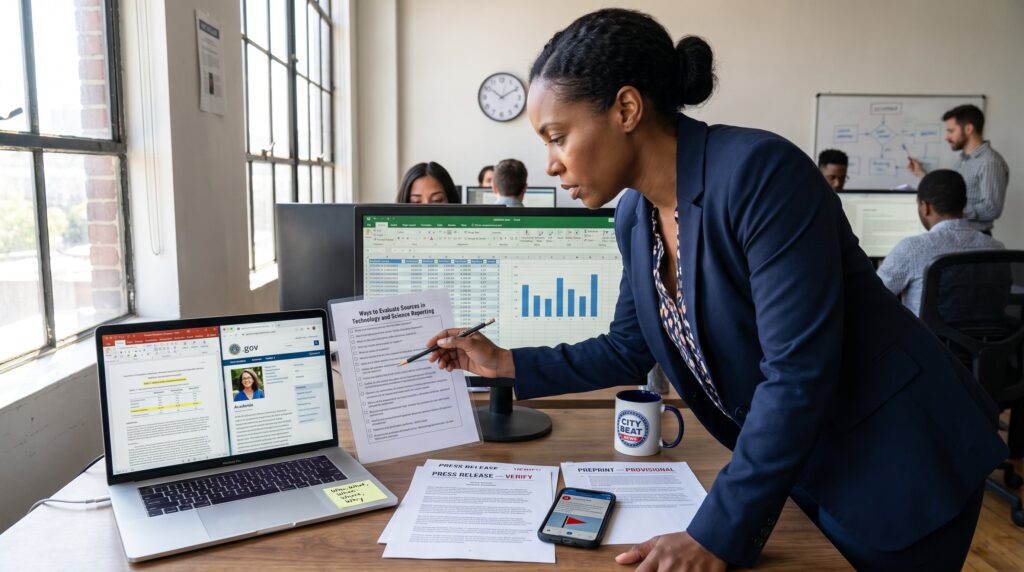
Ways to evaluate sources in technology and science reporting begins with fast, repeatable checks that protect accuracy and credibility. Journalists and editors working on fast-moving topics must confirm authorship, date, and publication type before relying on claims. This guide gives a compact, practical approach: a rapid checklist for breaking stories, a deeper verification workflow for data and methods, and clear signals that reveal bias or hidden interests. It aims to equip reporters and curious readers with concrete steps they can use immediately to avoid costly mistakes.
Key Takeaways
- Evaluate technology and science sources quickly using the 5Ws: who, what, when, where, and why to ensure credibility before relying on claims.
- Verify original research data and methods by checking sample sizes, study design, and cross-referencing multiple independent studies to support accurate reporting.
- Identify bias by examining funding sources, ownership, and language cues, and avoid misinformation tactics like cherry-picking or presenting preprints as settled science.
- Use rapid and thorough checklists combined with editorial standards to improve the accuracy and trustworthiness of technology and science reporting.
- Involve independent experts to clarify limitations and help readers understand complex scientific information confidently.
Practical Checklist For Rapid Source Evaluation
Answer first: use five quick questions, who, what, when, where, and why, to decide if a source is usable for a story.
Who: Confirm a named author or organization and check credentials. If an author lists an affiliation, verify it on the institution’s staff page. A social media profile alone does not prove expertise. For example, a software researcher with a university page and 18 peer-reviewed papers is more reliable than an anonymous blog post.
What: Identify the type of resource. A peer-reviewed journal article, a government report, a press release, a company blog, and a preprint all carry different trust levels. Treat press releases as claims that need independent confirmation. Treat preprints as provisional: they may change after peer review.
When: Check publication and last-updated dates. Technology stories about algorithms or vulnerabilities older than two years can be obsolete: climate or genomics studies may still be relevant but require context. Broken links or archived pages are a red flag.
Where: Prefer established publishers and platforms with editorial standards. Educational (.edu) and government (.gov) pages often document methods and data. Reputable journals list peer-review status and conflict disclosures.
Why: Read the piece’s stated purpose. Is it informational, persuasive, or commercial? Clear citations and data tables usually indicate an informative intent. If claims come with no sources and use sales language, treat them skeptically.
Practical checks to do in five minutes:
- Open the author’s profile and count relevant publications.
- Scan for funding or sponsorship statements.
- Find the original dataset or methods section: note sample size and dates.
- Look for corroboration from one other independent source.
Reporters who use this checklist avoid obvious traps. For newsroom training, pair this checklist with the site’s editorial primer: a short, useful internal link is the technology coverage guide. This helps new reporters align rapid checks with the site’s standards without slowing breaking coverage.
Deeper Verification: Data, Methods, And Peer Review
Answer first: deeper verification confirms whether data and methods actually support the headline claim.
Start by locating the original research. If a news item cites a study, follow that citation to the paper, preprint, or dataset. A true primary source shows methodology, sample size, statistical tests, and limitations. If a claim references research but links only to a press release, demand the paper. When available, cross-check the paper against other independent studies assessing the same question.
Examine methods with concrete tests. Note the sample size (e.g., 2,847 participants vs. 24), study design (randomized, observational, case study), and controls. Ask: could selection bias or confounding explain the result? If a machine-learning paper reports 98% accuracy, check whether that figure refers to a balanced test set or cherry-picked examples.
Evaluate data presentation visually. Charts can mislead: truncated axes, inverted scales, or selective data points change perception. Recompute simple numbers where possible: if a table shows a 15% reduction, verify the raw counts. Where data are open, run a quick script or use a spreadsheet to confirm key percentages.
Peer review matters but is not absolute. Peer-reviewed journals typically screen methods and conflicts, but errors still happen. Preprints can be valuable early signals but treat their conclusions as provisional. In fast-moving tech fields, a pattern of independent teams reproducing results is stronger evidence than a single paper.
For fact-checking practices, reputable organizations outline workflows. Journalists can study examples of organized fact-checking to refine thresholds: a useful external reference on how fact-check units operate is the Reuters fact check overview, which explains how reviewers weigh claims and harm when deciding verification steps.
A practical verification routine:
- Retrieve the original dataset or methods appendix.
- Note sample sizes and timeframes in plain numbers.
- Cross-check with at least two independent studies.
- Flag any missing code, opaque methods, or undisclosed exclusions.
Spotting Bias, Conflicts Of Interest, And Misinformation
Answer first: look for funding, ownership, language cues, and missing context to detect bias and misinformation.
Check funding and sponsorship with specifics. If industry funds a study, name the sponsor and note exact ties, was the funder the product owner or a neutral grantor? For example, a medical device study funded by the manufacturer requires cross-checks with independent trials. Look for explicit conflict-of-interest statements in the paper or press materials.
Investigate outlet ownership and editorial stance. Media outlets owned by advocacy groups or companies may present selective evidence. Find the outlet’s masthead and editorial policy pages and record exact ownership names and dates. Where possible, report the ownership chain in the article: that transparency helps readers weigh claims.
Watch language and framing. Sensational headlines, dramatic superlatives, or fear-based metaphors often signal persuasive intent rather than neutral reporting. Quantify the claim: replace vague terms like “many” with numbers when available. If a story says “most users,” reporters should ask: how many is most? Provide an exact figure or note the absence of one.
Beware of common misinformation tactics:
- Cherry-picking studies while ignoring contrary evidence.
- Presenting preprints as settled science.
- Missing citations or unverifiable quotes.
Use concrete examples from past errors to build newsroom practices. One team once published an AI benchmarking claim based on 12 curated examples: that mistake taught a newsroom to demand full evaluation sets and reproducible code before amplification.
When in doubt, seek independent expert commentary. A researcher unaffiliated with the study can explain limitations in plain terms. To help readers navigate the site’s science coverage, link to the internal summary that lists where science stories live and how they are selected with short anchor text like science stories index. Another useful site-level resource for newcomers is the site overview.
Conclusion
Reliable technology and science reporting depends on repeatable checks: the quick 5W checklist, careful validation of data and methods, and active scrutiny for bias and conflicts. Reporters who adopt these steps reduce error, build reader trust, and surface stronger, clearer stories. The investment in verification pays off: fewer corrections, clearer context, and reporting that stands up under scrutiny.