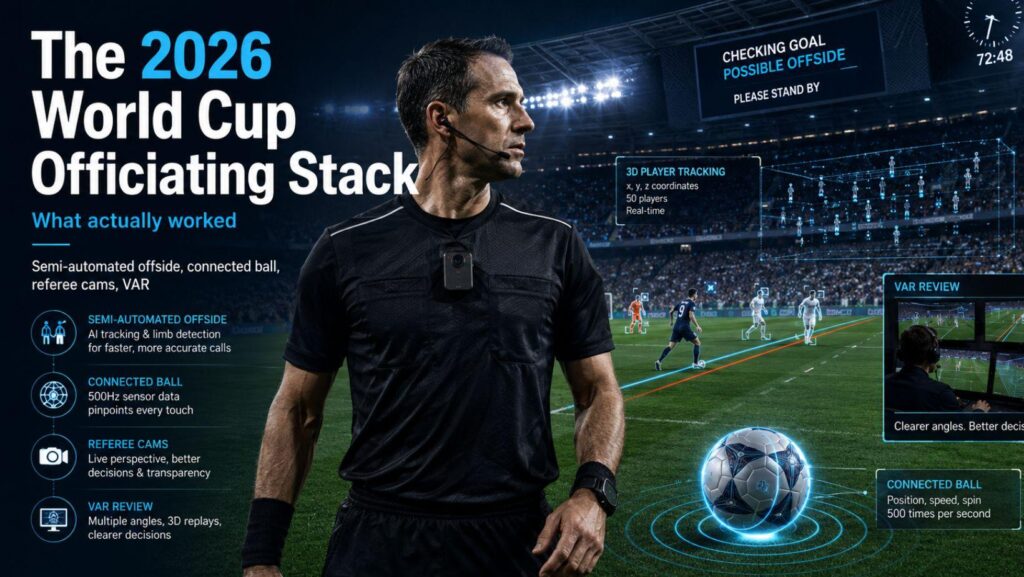
Before the 2026 World Cup, the conversation around refereeing technology sounded almost like a hardware launch.
Every one of the tournament’s 1,248 players had been 3D-scanned. The match ball carried a motion sensor. Stadiums were packed with optical tracking cameras. Clear positional offsides could be sent directly to assistant referees instead of taking the longer route through the VAR room. Referees wore head-mounted cameras. VAR decisions were explained over the stadium PA.
On paper, it was the most sophisticated officiating system football had ever used.
Then the knockout rounds arrived.
That matters because a technology that looks elegant during a group-stage match is one thing. A system that still feels useful when a goal in the 103rd minute of an elimination game depends on a contact nobody in the stadium saw is something else entirely.
By the end of the tournament, the verdict was mixed. The World Cup 2026 technology stack was genuinely better at answering certain factual questions. It was much less successful at solving football’s older problem: getting supporters to accept decisions whose logic they dislike. Understanding how these systems influence key moments can also help fans build a broader knowledge base before assessing matches, odds and betting markets, alongside practical resources such as a KY Lottery promo code.
Semi-automated offside was the clearest upgrade
The strongest piece of the entire system was the advanced version of semi-automated offside used in 2026.
This was not simply the Qatar 2022 system with better graphics.
At the previous World Cup, automated offside alerts were routed to the video officials, who checked the information before communicating with the referee team. In 2026, FIFA changed the workflow. When the system identified a clear positional offside, the information could be sent directly to the match officials on the pitch, allowing the assistant referee to flag immediately rather than waiting for the VAR room. FIFA said before the tournament that the change was intended both to speed up decisions and reduce the unnecessary continuation of plays after an obvious offside.
That distinction became more important than it sounded.
One of VAR’s most irritating side effects has always been the delayed flag. Everyone can see that a striker has probably gone too early, yet the assistant allows the move to continue because an incorrect early flag could kill a legitimate attack. Players then sprint another 40 metres, defenders make recovery tackles and goalkeepers throw themselves at shots from a sequence that may already be dead.
The 2026 system did not eliminate delayed flags, because it was never designed to make subjective calls about whether an offside player had interfered with play. But on straightforward positional offsides, it removed some of that dead time.
That was useful technology rather than decorative technology.
The additional 3D player scans also had a practical purpose. All 1,248 players were scanned before the tournament, creating individual digital models that could be incorporated into tracking and replay systems. The scans helped the technology represent each player’s actual body proportions rather than relying entirely on a generic model, while also making the eventual broadcast visualisations easier to read.
There was still a weakness, and it appeared early.
During Switzerland’s match against Qatar, the expected semi-automated graphic did not appear after a close incident before a Swiss penalty. FIFA later said the decision-making process itself had continued normally, but a temporary technical problem prevented the 3D onside animation from being generated and distributed.
That incident exposed an important distinction: decision technology and explanation technology are not the same thing.
The system could be working correctly behind the scenes while still appearing broken to everyone watching.
For semi-automated offside, though, the underlying product survived the tournament. It answered a narrow question: where were the players when the ball was played? , and generally answered it faster than the previous workflow.
That is exactly what automation in refereeing should do.
The Trionda sensor worked, but created a new argument
The adidas Trionda gave the system another layer of precision.
The principle was already familiar from previous FIFA tournaments: an inertial measurement unit inside the ball records movement at 500Hz, or 500 samples per second. That makes it possible to identify the moment of contact far more precisely than a human operator trying to choose the correct television frame. FIFA’s connected-ball system is specifically designed to feed that information into VAR and offside processes.
For ordinary offsides, this was difficult to argue against.
Offside requires two measurements: where the attacker and defender were, and when the pass was made. Improving the first while leaving the second dependent on somebody freezing a broadcast image would make little sense. The sensor solved the timing problem.
The more interesting test came when FIFA used the ball not merely to identify a kick point but to detect extremely faint touches.
Croatia’s knockout match against Portugal produced the tournament’s defining example. Joško Gvardiol appeared to score a dramatic late equaliser, only for the goal to be disallowed because connected-ball data detected a touch from Igor Matanović before the ball reached him. That touch created the relevant offside phase. Reuters reported that the contact was not obvious to the naked eye and that the ball showed little or no visible change of direction.
Technically, the system had done its job.
Culturally, it created a problem.
If the ball touched Matanović, the laws do not contain a clause saying that the contact must be visible enough to satisfy supporters watching television. Measurement technology is supposed to detect things humans miss.
Yet Croatia’s complaint that this amounted to an “abuse of technology” captured something important. The more sensitive the equipment becomes, the more football has to decide whether every measurable event should automatically become an officiating event.
That is not an engineering question.
It is a rules question.
The Trionda sensor therefore belongs in the “worked” column, but with an asterisk. It provided exceptionally useful factual evidence. What football has not settled is how aggressively that evidence should be used.
Referee body cameras were better television than better refereeing
The referee camera was probably the most visible innovation that changed almost nothing about how a match was actually decided.
FIFA had trialled body cameras at the 2025 Club World Cup and brought them to the 2026 World Cup with improved stabilisation technology designed to reduce the blur created by referees running, turning and changing direction. FIFA described the aim as giving viewers a clearer first-person perspective and improving understanding of what officials see on the pitch.
As a broadcast feature, it worked.
The images could show how little space a referee sometimes has between players, how quickly an incident develops and how different a challenge looks from field level compared with the familiar elevated television angle. The camera was also effective for atmosphere: confrontations, goals, set pieces and moments when players crowded an official suddenly felt much closer.
That has value.
But calling it a transparency revolution would be generous.
The camera showed the referee’s visual perspective. It did not reveal the referee’s reasoning. It did not automatically tell viewers what the VAR was checking, what replay angle mattered or why one contact was considered careless while another was judged incidental.
In that sense, Referee View solved the least difficult part of the transparency problem.
Supporters rarely complain because they have never seen what the referee was physically looking at. They complain because they do not understand why a particular law or threshold was applied.
The body cam was excellent television. As officiating infrastructure, it was secondary.
VAR announcements helped, but only after the important conversation was over
Having referees announce the outcome of VAR reviews inside the stadium was sensible.
FIFA had already used referee announcements at earlier tournaments. After an on-field review, the referee can use a microphone to tell spectators the final decision and briefly identify the offence involved.
This is clearly better than the old routine.
Previously, a crowd might watch a referee stand beside a monitor, see players arguing, wait through multiple replays and then discover the outcome from a hand signal. Anyone sitting behind the goal could spend several minutes wondering what was actually being reviewed.
The announcement at least closes that information gap.
But it remains a very limited form of transparency.
It tells the audience what was decided, not necessarily how the decision was reached.
That distinction became more obvious during a tournament in which VAR itself became part of several major controversies. Reuters reported that the number of VAR interventions rose rapidly compared with the 2018 and 2022 World Cups, while criticism focused increasingly on the scope and consistency of intervention rather than on whether the technology could detect incidents.
If supporters have just watched a goal overturned because of a foul earlier in the move, hearing the referee announce that a foul occurred does not answer the obvious next question: why was that particular contact serious enough for VAR to intervene?
Announcements are useful. They are not the same as opening the process.
Football still keeps the most interesting information — the live conversation between referee and VAR — largely out of public reach.
The knockout rounds exposed the real limit of VAR
The 2026 World Cup did not prove that technology cannot referee football.
It proved that different decisions have different levels of suitability for technology.
Offside position is highly measurable.
Whether the ball crossed a line is measurable.
Whether somebody touched the ball can now be measured with extraordinary sensitivity.
Whether a challenge constitutes a clear and obvious error is different.
That remained the weak point.
By the round of 16, arguments were no longer mainly about whether the cameras had seen enough. They were about how much VAR should be allowed to correct.
Egypt were angered after a goal against Argentina was disallowed for a foul earlier in the attacking sequence. England manager Thomas Tuchel questioned the threshold for intervention after a VAR decision against his side. FIFA refereeing chief Pierluigi Collina defended the broader approach, arguing that a foul missed by the referee could still justify intervention regardless of how far before the eventual goal it occurred.
None of those disputes could have been solved by another camera.
That is the biggest lesson from 2026.
The technology became much better at producing evidence. The rules governing when that evidence should override an on-field decision remained open to interpretation.
So what actually worked?
The winners were the systems with narrow jobs.
Advanced semi-automated offside made obvious positional offsides quicker. The 3D scans improved tracking and made replays clearer. Connected-ball technology gave officials an extremely precise way to determine when the ball had been touched. Goal-line technology continued doing what good officiating technology should do: quietly answer a binary question and disappear.
The less convincing parts were the technologies sold primarily in the language of transparency.
Referee cameras gave broadcasters excellent footage, but they did not explain decisions. Stadium announcements were an improvement, but they communicated conclusions rather than deliberations. Even the polished 3D offside graphics proved how fragile transparency can be: when one failed to appear in the Switzerland-Qatar match, the absence of an explanatory image immediately produced suspicion despite FIFA saying the underlying VAR process had continued normally.
That may be the most useful post-tournament verdict on World Cup 2026 technology.
The best systems did not try to replace refereeing. They removed a specific uncertainty.
Where was the player?
When was the ball touched?
Did the ball cross the line?
Those are problems computers are good at solving.
The tournament became messier when technology moved from measuring events to expanding the number of incidents that could be re-refereed.
Football entered the 2026 World Cup with more information than any tournament before it. It left with the same old argument about what officials should do with that information.
The next step, therefore, probably does not require another sensor.
It requires a clearer answer to a much more human question: when should the technology stay out of the game?