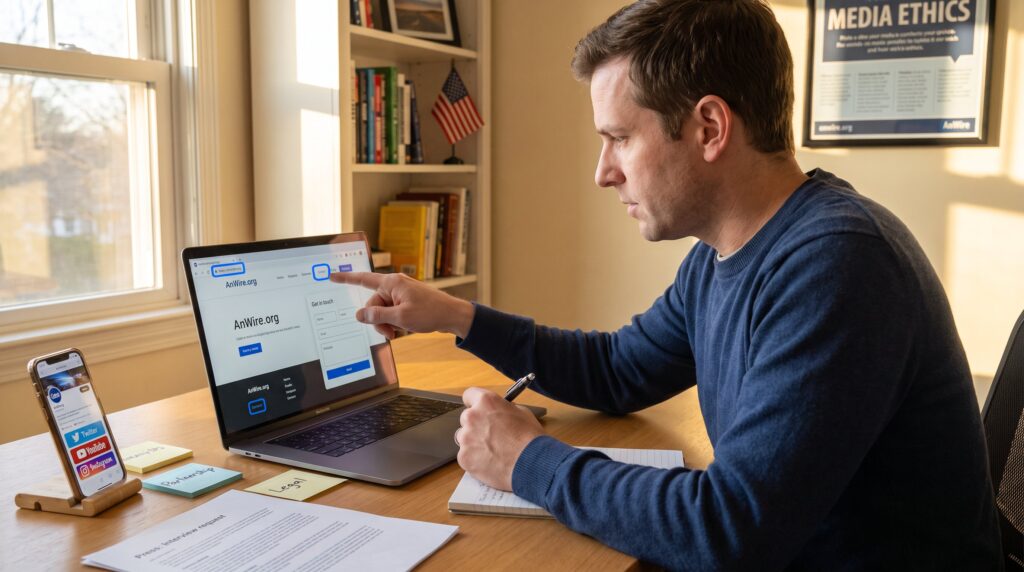
AnWire.org contact information appears on the site’s main contact resources and navigation menus. This guide shows where to find the official contact page, which addresses and forms to use, and which public channels work best for quick replies. Readers who need press, partnership, or editorial contact will learn which route fits their goal and how to confirm they are on the genuine anwire.org domain before sending sensitive material.
Key Takeaways
- The official AnWire.org contact page is typically found in the header or footer under labels like “Contact” or “Get in touch.”
- Use the contact form on AnWire.org for general and editorial inquiries to ensure faster routing to the appropriate team.
- Confirm you are on the authentic anwire.org domain before submitting sensitive or legal information to avoid spoofed or outdated contacts.
- For press, partnership, advertising, and legal inquiries, use the specifically labeled emails or dedicated contact form sections to prioritize business-related matters.
- Social media channels serve best for quick public questions and updates but avoid sharing confidential information there.
- Keep clear records of all submissions and verify your chosen contact method aligns with your inquiry to speed up response times.
How To Locate AnWire.org’s Official Contact Page And Site Navigation Tips
Start with the fact: the official contact page usually sits at a clear path like /contact/ and appears in the top menu or the footer. From the homepage, users should scan the header and the footer for links labelled “Contact,” “Get in touch,” or “About.” If the top menu shows many topic categories (Babies, Health & Wellness, Science), the footer is the most reliable spot to find the contact link without hunting.
Practical navigation tip: use the browser’s find feature (Ctrl/Cmd+F) and search for “contact” on the home page. If site navigation changes, the same page is often mirrored in a “Connect” section or in an “About” page. Visitors who prefer guided steps can consult the short site walkthrough offered in the visit guide that explains menu labels and where contact links commonly live.
Verification step: always confirm the domain reads anwire.org and check for an updated timestamp or “last updated” note on the contact page. This reduces the risk of sending information to stale or spoofed forms. If a user still can’t find a direct contact link, the site’s central page listing and usage guide provides alternate paths to reach staff via the site map and recommended pages.
Email Addresses, Contact Forms, And Best Practices For Submissions
Fact first: AnWire.org primarily uses a contact form and one or more generic emails for inquiries and submissions. For a formal request, the contact form routes messages to the correct team faster than an unaddressed inbox note.
How to prepare a submission: identify your purpose, editorial pitch, collaboration, tip, or corrections, and choose the matching subject line. Provide a concise summary (50–100 words), one or two relevant links, and a clear deadline when applicable. For example, a freelance pitch that names the suggested angle, target audience, and two sample hooks increases the chance of reply.
Pitching guidance: NPR and other newsrooms recommend brief, specific pitches that state the story value in the first line. Reporters at large outlets prefer the same clarity, so structuring a submission with a one‑sentence hook followed by three supporting bullets is effective (what makes a good pitch?).
Form vs email: use the form for general and editorial queries. Use the listed email for partnership or legal notices if the contact page specifies separate addresses. When a special address isn’t shown, label the subject clearly (e.g., “Press: Interview request, study release”) and attach a short, plain-text bio. Keep copies of sent messages and timestamps to track follow-ups.
Social Media, Video Channels, And Other Public Messaging Options
Clear answer: social handles and channels are best for public engagement and quick confirmations, not for confidential submissions. AnWire.org often uses unified social tags and a video channel for community interaction and topical updates. For background on how these pieces fit together, see the science overview.
Where to look: search major platforms for an official handle like @anwire.org or the site name: pinned posts or the profile bio usually list the contact link or an email. Users seeking fast, public responses should post a polite query or direct message on the appropriate platform. Do not include private documents or attachments in public posts.
Use case example: a reader reporting a broken article link can tweet a short report and link the page: that typically triggers a faster fix than waiting weeks for an email response. For content creators, the video channel is a place to suggest collaboration ideas but proposals that include attachments should still use the site’s secure form or an email address specified on the contact page.
Related pages: community and blog sections explain how AnWire.org uses social to surface stories: the site’s community hub summarizes where discussions happen and how to join the conversation on social platforms. For people who want a quick orientation before messaging, the site guide shows where social links appear on the page.
Press, Partnership, Legal, And Advertising Contact Routes
Direct fact: press, partnership, advertising, and legal inquiries should use clearly labelled channels on the contact page, or be routed through a business-specific email when listed. Business matters get prioritized differently than reader feedback.
How to route a press request: if a “Media” or “Press” address exists, use it and clearly mark the subject line (e.g., “Press: data source question”). If no dedicated press channel appears, route the request via the main contact form and start the message with “Press inquiry:” so staff can triage it. Partnership proposals should open with one paragraph describing the mutual benefit, projected timeline, and one measurable goal (clicks, impressions, or joint event date).
Advertising and legal notices: advertising requests often include a media kit or rate card: ask for specifications and expected run dates in the initial message. Legal notices and copyright takedown requests require exact details: the contested URL, the copyrighted work, and a signature or authorized representative. When uncertain about procedures, the site’s procedural overview clarifies common workflows and contact expectations in depth via its page guide.
A cautionary note: never send sensitive legal documents to social channels. Use a direct email or the secure contact form and request a read receipt or confirmation to document delivery.
Conclusion: Choosing The Right Channel And Verifying Contact Information
Choose the channel that fits the goal: use the contact form or labeled email for formal submissions, social for quick public queries, and the press/partnership addresses for business matters. Verify you are on the official anwire.org domain and keep records of sent messages.
Final tip: when in doubt, reference the site’s hub and coverage primer to match your query with the right desk. A short check of the site’s topical guide reduces misdirected messages and speeds up the correct reply.