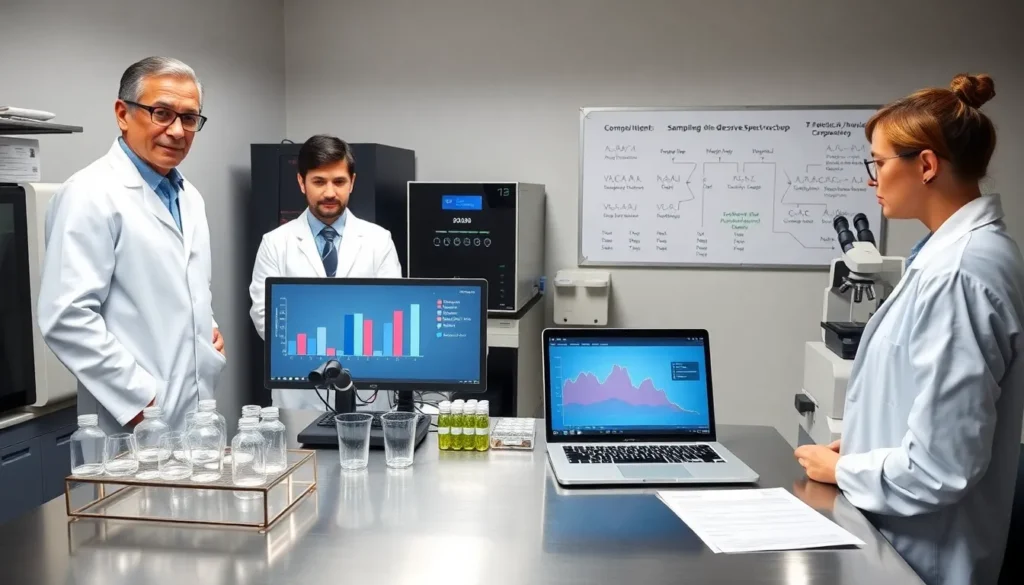
Composition in science explains what materials contain. It shows which parts form a sample. The term guides analysis, design, and safety. Readers learn core ideas and methods here.
Key Takeaways
- Composition in science identifies what parts make up a sample and quantifies them to guide analysis, design, and safety decisions.
- Choose composition methods by scale and question—atomic and isotopic analyses, spectroscopy, mass spectrometry, X-ray techniques, and imaging each suit different levels of detail.
- Report composition in clear units (weight %, mole fraction, ppm, molarity), include uncertainty and detection limits, and follow field standards for notation and metadata.
- Ensure representative sampling and validate composition results with standards, replicates, and orthogonal methods to reduce bias and matrix effects.
- Leverage emerging tools—machine learning, portable sensors, and in‑situ analysis—to expand real‑time composition in science capabilities and improve interpretation of multimodal data.
What “Composition” Means in Scientific Contexts
Composition in science means the identity and amount of parts that make a sample. Scientists describe composition by naming components and by measuring their amounts. Composition can refer to atoms, molecules, phases, or whole subsystems. Scientists use composition to compare samples, track change, and test hypotheses. The term guides experimental design and instrument choice.
Levels Of Composition: From Elements To Complex Systems
Composition in science appears at many scales. At the atomic scale, composition refers to elements and isotopes. At the molecular scale, composition refers to bonded atoms and functional groups. At the material scale, composition refers to phases, mixtures, and defects. At the system scale, composition refers to components, subsystems, and interactions. Each level requires different methods and different interpretation.
How Scientists Determine Composition
Scientists select methods based on sample type and question. They prepare samples to avoid contamination and loss. They apply instruments that measure identity or amount. They validate results with standards and replicates. They report uncertainty and detection limits. This workflow helps ensure that reported composition is reliable.
Why Composition Matters: Key Applications And Implications
Composition in science affects performance, safety, and regulation. Engineers use composition to design alloys and polymers for strength or weight. Clinicians use composition to detect biomarkers and guide treatment. Environmental scientists use composition to track pollutants and compliance. Astronomers use composition to infer origin and history of objects. Policymakers use composition data to set limits and standards.
Common Methods For Representing And Reporting Composition
Scientists report composition in clear numeric terms. They use weight percent, mole fraction, and concentration units. They include uncertainty and method details. They use tables, charts, and maps to show spatial variation. They follow field standards for notation and metadata to aid reuse.
Practical Examples And Case Studies
This section gives applied examples of composition in science. Each example shows methods and outcomes.
Definitions And Core Concepts
Scientists define composition in relation to component identity and amount. They separate qualitative description from quantitative measurement.
Distinguishing Composition From Structure And Properties
Scientists note that composition differs from structure and from properties. Composition lists parts. Structure shows arrangement. Properties describe behavior.
Atomic And Molecular Composition
Chemists report element types and molecular formulas. Isotope ratios can also form part of composition.
Compound And Mixture Composition
Analysts distinguish pure compounds from mixtures. They quantify each phase or species in a mixture.
Organizational And Systems-Level Composition
Ecologists and engineers list subsystems and material flows. They measure component fractions and interaction strengths.
Qualitative Vs Quantitative Composition Analysis
Qualitative methods identify components. Quantitative methods measure amounts. Good reports combine both.
Challenges, Limitations, And Future Directions In Composition Analysis
This section discusses limits and new directions.
Spectroscopy (IR, UV-Vis, NMR), What Each Reveals
IR shows bond types. UV-Vis shows chromophores and concentration. NMR shows molecular framework and relative amounts.
Mass Spectrometry And Chromatography, Identification And Quantification
Mass spectrometry identifies mass and fragments. Chromatography separates complex mixtures. Analysts combine them for confident composition data.
Elemental Analysis And X-Ray Techniques (XRF, XRD)
XRF measures elemental content. XRD identifies crystalline phases. Both help define material composition.
Microscopy And Imaging Approaches For Spatial Composition
Electron and optical microscopy map composition at small scales. Energy-dispersive spectroscopy adds elemental data to images.
Materials Science And Engineering (Alloys, Polymers, Composites)
Materials scientists report composition to predict strength and durability. Small changes in composition can change performance.
Environmental Science (Soil, Water, Air Pollutants)
Environmentalists measure composition to track contaminants and exposure. They report concentrations in mass per volume or in parts per million.
Biology And Medicine (Biomolecular And Tissue Composition)
Biologists measure protein, lipid, and nucleic acid composition. Clinicians measure blood and urine composition to diagnose disease.
Astronomy And Planetary Science (Spectral Composition Of Celestial Bodies)
Astronomers record spectral lines to infer elemental and molecular composition. They use composition to infer formation history.
How To Report Composition: Percentages, Ratios, And Concentrations
Reports use percent, ratio, and molarity to express composition. Authors note units and reference states.
Standard Notation And Units (Molarity, Mass Fraction, ppm)
Scientists use molarity, mass fraction, and ppm. Clear units prevent misinterpretation.
Visual Tools: Pie Charts, Stacked Bars, And Composition Maps
Visuals show relative parts and spatial variation. They help readers grasp composition quickly.
Industrial Quality Control And Forensics
Industries check composition to meet specs. Forensics use composition to link samples and sources.
Conservation, Restoration, And Cultural Heritage Analysis
Conservators measure composition to choose safe treatments. They track pigments, binders, and residues.
Limitations Of Techniques (Sensitivity, Resolution, Matrix Effects)
Each method has detection limits and interference. Analysts select methods that suit sample matrices.
Sampling Challenges And Representativeness
Sampling can bias composition results. Good sampling plans aim for representativeness.
Interpreting Composite Or Multimodal Data
Analysts integrate multiple data types. They use statistics and cross-validation to increase confidence.
Emerging Tools: Machine Learning, Portable Sensors, And In-Situ Analysis
Researchers apply machine learning to detect patterns in composition data. Portable sensors enable field composition measurements. In-situ tools reduce sample change during transport.