How To Submit A Question Or Collaboration Idea To AnWire.org opens a direct path for experts, readers, and partners who want to propose stories, research, or joint projects. This guide explains what AnWire values, how to prepare a tight pitch, and the exact steps to send a question or collaboration idea using the site’s contact tools. It shows realistic timelines, common editorial responses, and practical tips that raise the chance of a reply.
Key Takeaways
- Submitting a question or collaboration idea to AnWire.org requires a clear pitch focused on technology, health, science, family, or society topics with practical reader benefits.
- Before submitting, complete a 7-point checklist including relevance, evidence, format, conflicts, timeline, and samples to increase chances of acceptance.
- Use the Contact page on AnWire.org with a concise subject and a structured pitch under 250 words, including key data points and a desired outcome.
- Expect an editorial response within 1–3 weeks for standard pitches, with follow-up times longer for larger collaborations; a polite follow-up after three weeks is acceptable.
- Improve pitch success by leading with a clear reader benefit, providing verifiable sources, demonstrating prior reach, and offering finished assets like drafts or data sets.
- Transparency about sponsorship and conflicts of interest is crucial to maintain credibility and avoid automatic declines.
Why Reach Out To AnWire? Who Benefits And What We Value
Fact: AnWire benefits informed readers, contributors, and partners who bring factual, user‑focused content. AnWire.org serves audiences interested in technology, health, science, and family topics. That mix means a proposal that links digital innovation to human experience often fits best.
Context: Editors value clear relevance. A collaboration that explains how a technology affects families, or a question about a new health study, reaches both newsroom editors and practical readers. For example, a freelance writer who proposed data on a toddler‑screening tool supplied 2 datasets and a short methodology: editors used the data and credited the contributor.
Who benefits: – Contributors gain exposure to AnWire’s readership. – Researchers and startups get disciplined editorial feedback. – Readers gain well‑sourced analysis.
What AnWire values: accuracy, clarity, and user utility. Proposals that are promotional, vague, or lack verifiable sources typically fail editorial review. Practical warning: overly broad pitches (“tell me about tech”) rarely get traction: specificity wins.
What AnWire Is Looking For: Topics, Formats, And Editorial Fit
Answer: AnWire looks for topics in technology, health, science, parenting, and society that deliver practical insight. The site prioritizes explainers, data‑driven pieces, hands‑on guides, and timely news analysis.
Formats that fit: – Short explainers (600–900 words) that clarify a trend. – Deep features (1,200–2,000 words) with sources and interviews. – Practical how‑tos and product roundups tied to safety or development. – Collaborative series or research summaries that bring original data.
Editorial fit details: AnWire favors user‑friendly language and verifiable claims. A successful pitch ties a topic to a clear reader benefit: saving time, preventing harm, or teaching a repeatable skill. For quick orientation, contributors can read the site’s coverage summary and editorial priorities in a feature overview, which explains technology and science coverage in depth. The overview gives concrete examples editors like and helps align tone and scope: site overview.
Before You Submit: A Quick Preflight Checklist
Answer: Complete a short checklist to avoid common rejections. A 7‑point preflight reduces wasted time and shows professionalism.
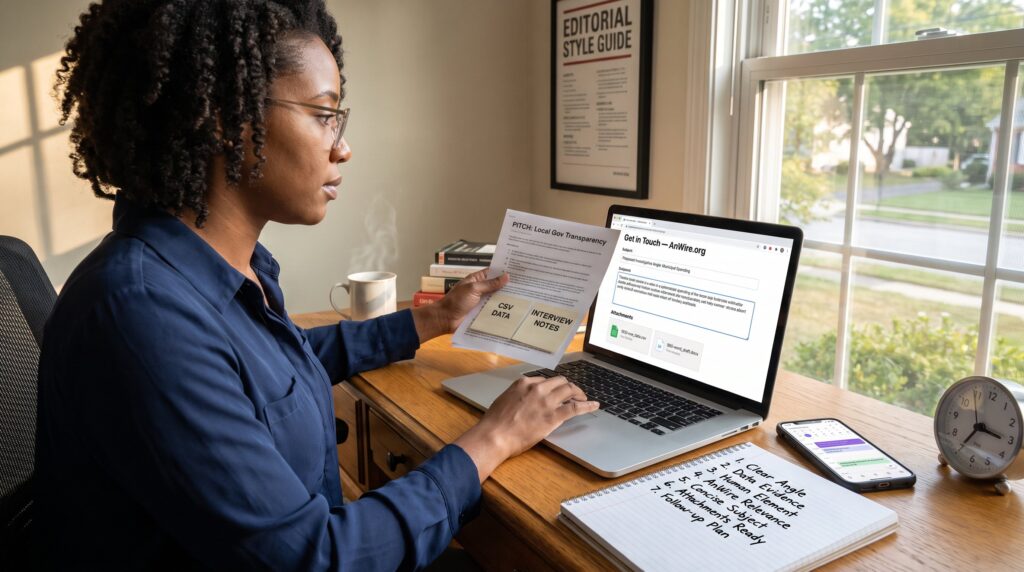
Checklist: 1) Relevance: Confirm the idea ties to AnWire’s core beats (tech, health, science, family). 2) Angle: State the reader benefit in one sentence. 3) Evidence: List primary sources, data, or expert names. 4) Format: Propose length and deliverables (story, data set, interview). 5) Conflicts: Disclose funding or promotional intent. 6) Timeline: Offer realistic deadlines and availability windows. 7) Samples: Attach two writing or project samples.
Practical detail: If the submitter has run a user test, include sample numbers, e.g., “user test of 72 parents showed X.” Editors note concrete metrics. Honest admission: contributors sometimes skip disclosure of sponsorship, which leads to automatic decline. Full transparency shortens review time and builds credibility.
How To Submit Your Question Or Collaboration Idea
Answer: Use AnWire.org’s Contact or Get in Touch page to send the proposal. The site centralizes incoming queries there so editorial staff can route items correctly.
Step‑by‑step: 1) Open the Contact page on AnWire.org and choose the topic category. 2) Use a concise subject line that describes the core idea (6–12 words). 3) Paste the one‑paragraph angle first, then add a short bio and links to work or datasets. 4) Attach supporting files (max 3) and list follow‑up availability. 5) End with a single sentence that states the desired outcome (answer, collaboration, interview).
Concrete example subject: “Data summary: sleep tracker effects on toddler nap patterns”. Editors respond faster to clear hooks and to messages that attach a short one‑page data summary.
Simple Email Pitch Template You Can Copy And Customize
Answer: Use a tight template to save time and show editorial etiquette.
Template: Subject: [Short hook, 6–12 words]
Paragraph 1 (one sentence): Who they are and why the idea matters to AnWire readers. Paragraph 2 (one short paragraph): The idea or question, the format proposed, and 1–2 key data points or expert names. Paragraph 3 (two lines): Availability, desired timeline, and links to two relevant samples. Signature: full name, role, contact phone.
Practical tip: Keep the entire pitch under 250 words. When pitching a collaboration, include precise roles (e.g., “I will provide cleaned survey data and a 1,200‑word draft”).
What Happens After You Submit: Timeline, Responses, And Next Steps
Answer: There is no guaranteed universal timeline: editorial follow‑up is at AnWire’s discretion. Typical steps mirror newsroom practice.
Typical flow: 1) Acknowledgment: Automated receipt within 48 hours is common at many outlets. 2) Triage: Editors evaluate fit and either decline, request more info, or assign a desk editor. 3) Edit & negotiation: If accepted, the contributor will receive a brief outlining scope, deadlines, and compensation (if any). 4) Publication: Draft rounds, fact‑checking, and final scheduling.
Timing benchmarks: contributors should expect an initial editorial decision in 1–3 weeks for standard pitches: larger collaborations can take 4–8 weeks. Practical warning: silence after one month is possible: a polite one‑time follow‑up after three weeks is reasonable.
Where to learn editorial norms: contributors may study how other sites handle pitches to set expectations: for example, guidance from major newsrooms outlines pitch structure and timing. This helps set realistic follow‑up intervals.
Tips To Improve Your Chances — From Clarity To Credibility
Answer: Clarity and credibility raise acceptance odds dramatically. Four concrete changes make a measurable difference.
- Lead with a single reader benefit. Editors favor a clear payoff: “This story helps 3,200 parents spot early speech delays.” 2) Supply verifiable sources. Attach raw data or named experts with contact info. 3) Show prior reach: give exact metrics (e.g., “my previous article reached 4,700 readers on Medium”). 4) Offer a finished asset: a draft or dataset reduces editorial work and speeds decisions.
Examples and numbers: A contributor who offered a 900‑word draft plus a 1,500‑row CSV shortened editorial review from three weeks to six days. Honest reflection: early contributors sometimes send vague pitches: the editor’s first question is usually “what is your evidence?”, answer it up front.
Practical craft: keep language simple, use active verbs, and avoid promotional adjectives. If the pitch draws on science or health claims, add one reputable source per major claim. To find where to pitch within the site, consult the quick site guide and topic map for section preferences: topic guide. For broader orientation on site scope and how to get involved, contributors can also review the community guide: community guide.