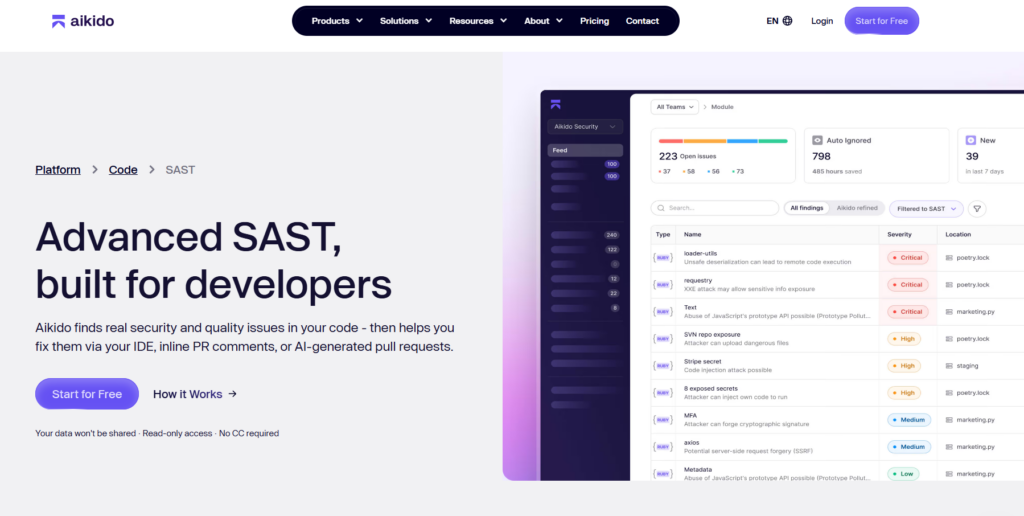
SAST remains one of the most important layers of modern application security. By identifying vulnerabilities directly in source code before deployment, SAST helps development teams reduce security risks early in the software lifecycle.
Two platforms that frequently appear on enterprise shortlists are Aikido Security and SonarQube. While both offer static code analysis capabilities, they approach application security from very different perspectives.
Quick Comparison By Category
|
Category |
Winner |
Reason |
|
Code Quality |
SonarQube |
Industry-leading code quality analysis and technical debt management |
|
Security Coverage |
Aikido |
Broader AppSec capabilities beyond SAST |
|
Tool Consolidation |
Aikido |
Replaces multiple security products |
|
Self-Hosting |
SonarQube |
Mature on-premise deployment options |
|
DevSecOps Simplicity |
Aikido |
Single platform approach |
Aikido Security
Aikido Security is an all-in-one application security platform designed to secure the entire development lifecycle. Beyond SAST, it combines SCA, secrets detection, container scanning, cloud security, DAST, runtime protection, and attack surface monitoring in a single platform.
Its DAST and surface monitoring capabilities dynamically test web applications and APIs using simulated attacks to identify exploitable vulnerabilities.
Key Strengths
- Unified code-to-cloud security platform
- SAST, SCA, DAST, secrets detection, and cloud security in one dashboard
- Context-aware vulnerability prioritization
- AI-assisted remediation workflows
- Attack surface monitoring
- Runtime protection capabilities
- Fast cloud-native deployment
- Developer-friendly pull request integrations
Limitations
- Organizations focused solely on code quality may not need the broader security platform
SonarQube
SonarQube has been a staple of software quality management for many years. It is known for helping development teams improve maintainability, reliability, and code quality while also offering security-focused static analysis.
Key Strengths
- Mature and established platform
- Good code quality metrics
- Broad programming language support
- Flexible self-hosted deployment options
- Large enterprise customer base
- Well-known among development teams
- Additional tooling may be needed for broader AppSec coverage
- Security workflows can feel fragmented compared to unified AppSec platforms
- Setup and maintenance requirements can be higher for self-managed deployments
Where Aikido Stands Out
Aikido takes a unified, developer-first approach to application security by combining code scanning, dependency analysis, and attack surface monitoring into a single platform that reduces fragmentation across security tools.
Broader Security Coverage
- Modern applications face risks beyond source code vulnerabilities. Dependencies, exposed secrets, cloud misconfigurations, containers, and internet-facing assets all contribute to the attack surface.
- Aikido addresses these areas through a unified platform rather than requiring multiple standalone tools. This broader approach reflects how many security teams are shifting toward platform consolidation.
Attack Surface Monitoring and DAST
One major differentiator is that Aikido extends beyond static analysis. The platform includes:
- Dynamic Application Security Testing
- External attack surface monitoring
- Runtime protection features
- Autonomous security testing capabilities
Reduced Security Tool Sprawl
- Many teams today operate separate tools for: SAST, SCA, secrets scanning, DAST, container & cloud security.
- Security practitioners frequently note that managing overlapping tools can create operational complexity and duplicate findings. A unified platform can simplify ownership, triage, and remediation workflows.
Developer Experience
Aikido emphasizes developer-centric workflows, surfacing findings directly within pull requests and prioritizing vulnerabilities based on exploitability and context. This can reduce noise and improve remediation efficiency.
Where SonarQube Stands Out
SonarQube is still one of the strongest tools for maintainability analysis, technical debt reduction, code smell detection, reliability improvements, and development governance.
Organizations often choose SonarQube because existing CI/CD integrations are mature, and internal processes are built around Sonar quality gates. For organizations with strict infrastructure requirements, SonarQube's self-hosted deployment options remain attractive.
Which Platform Should You Choose?
Choose Aikido Security if:
- Security is your primary goal
- You want to consolidate multiple AppSec tools
- You need DAST and attack surface visibility
- You want a cloud-native developer experience
- Your team values contextual prioritization over large alert volumes
Choose SonarQube if:
- Code quality is the primary priority
- You already have separate security tooling
- You require mature self-hosted deployments
- Your workflows are heavily built around Sonar quality gates
Final Verdict
There's no single best SAST tool for every team. The right one depends on your stack, your budget, and the security goals you're trying to achieve.
Before committing to any platform, consider these three important things:
If you want comprehensive application security coverage with built-in DAST, cloud monitoring, and developer-friendly workflows all in one platform, Aikido Security is a solid choice.