
Spotting a threat is only half the battle. In a world where attacks unfold in minutes and defenders face nearly 2,000 of them a week, the gap between detection and response often decides whether an incident stays small or becomes a headline. That is why AI cybersecurity has expanded well beyond detection into the response itself, automating the containment and recovery steps that once waited on a busy analyst. IBM’s 2025 research puts the average breach lifecycle at 241 days, and the biggest reductions come from shrinking that clock. This article traces the role AI plays across the full lifecycle, from the first anomaly to complete recovery, and where human judgment still has to lead. The shift matters because attackers already operate at machine speed, so matching them on detection but not on response simply moves the bottleneck. For enterprises, the practical question has moved from whether to use AI to how far to let it act.
Key Takeaways
- AI now works across the whole lifecycle, from spotting threats to automating containment and recovery.
- A typical breach runs 241 days from first intrusion to full containment, and AI compresses both phases.
- Automated response can quarantine devices, block traffic, and disable accounts in seconds.
- Firms leaning hard on AI defenses save on the order of 1.9 million per incident.
- Complete automation is rarely wise, so people should keep control of high-stakes, irreversible actions.
AI Across the Security Lifecycle
Understanding AI cybersecurity across the lifecycle means looking past detection alone. Current guidance, including the latest national incident framework, describes security as a continuous cycle of detect, respond, and recover, all wrapped in ongoing governance. AI now contributes at every step of that cycle.
Where older tools stopped at raising an alarm, AI-driven systems carry the work forward, sorting the alert, investigating it, and often beginning to contain the threat before a human even opens the ticket. The effect is a defense that moves much closer to the speed of the attack itself. This lifecycle view also reframes what good security looks like. Rather than a wall meant to keep everything out, it becomes a loop that detects, responds, learns, and improves with every incident, and AI is what makes running that loop at scale realistic.
Detection: Catching More, Sooner
It starts with detection. Machine learning models learn a baseline of normal behavior across networks, endpoints, and identities, then flag the deviations that signal an attack, including novel threats with no signature covers.
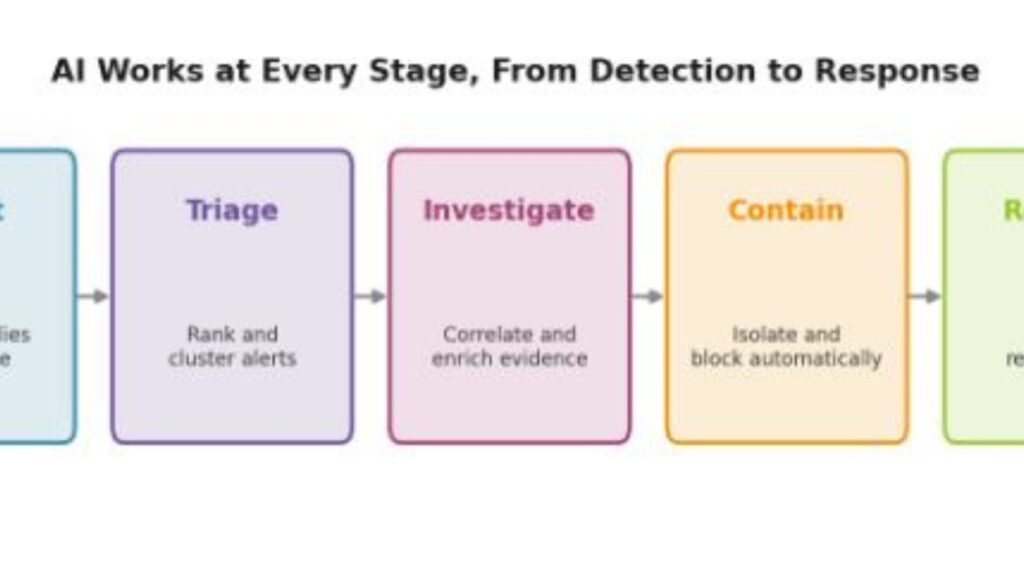
AI adds value at each phase, not just the moment a threat appears.
This is the same intelligence powering modern, AI-driven network operations centers, which predict incidents, correlate thousands of daily alerts, and rank them by severity. By clustering related signals into a single story, AI turns an unmanageable stream of noise into a short list of real incidents worth acting on. That triage step is quietly transformative. A mid-sized team can drown under tens of thousands of daily events, and without help most are never reviewed. By surfacing the handful that matter, AI lets analysts spend their hours on judgment rather than sorting.
Response: Acting at Machine Speed
Detection buys nothing if response lags behind. This is where AI has changed the game most, moving from giving advice to taking action.
| Stage | What AI does | Example action |
|---|---|---|
| Detect | Flags anomalies in real time | Surfaces an unusual login |
| Triage | Scores and ranks alerts | Pushes the critical one first |
| Investigate | Correlates and enriches | Builds the attack timeline |
| Contain | Executes response playbooks | Quarantines the affected device |
| Recover | Guides remediation | Restores systems and closes gaps |
Automated playbooks can now isolate a compromised endpoint, block a malicious address, or disable a stolen account in seconds, long before an on-call analyst could react. This aligns with established incident response guidance, which explicitly endorses automating alerts, triage, and coordination. The newest tier, agentic AI, goes further still, planning and carrying out multi-step responses on its own within set guardrails. The practical payoff is speed measured in seconds rather than hours. When a phishing click or credential theft is caught, an automated workflow can pull the affected machine off the network, revoke the session, and open a ticket before the attacker moves laterally. At that moment, speed is often the difference between a contained event and a company-wide breach.
The Payoff Across the Lifecycle
The gains are measurable, and they concentrate in time. IBM found the average breach takes 181 days to identify and another 60 to contain, and organizations that use AI extensively across their defenses close incidents about 80 days faster while saving close to 1.9 million dollars per breach.
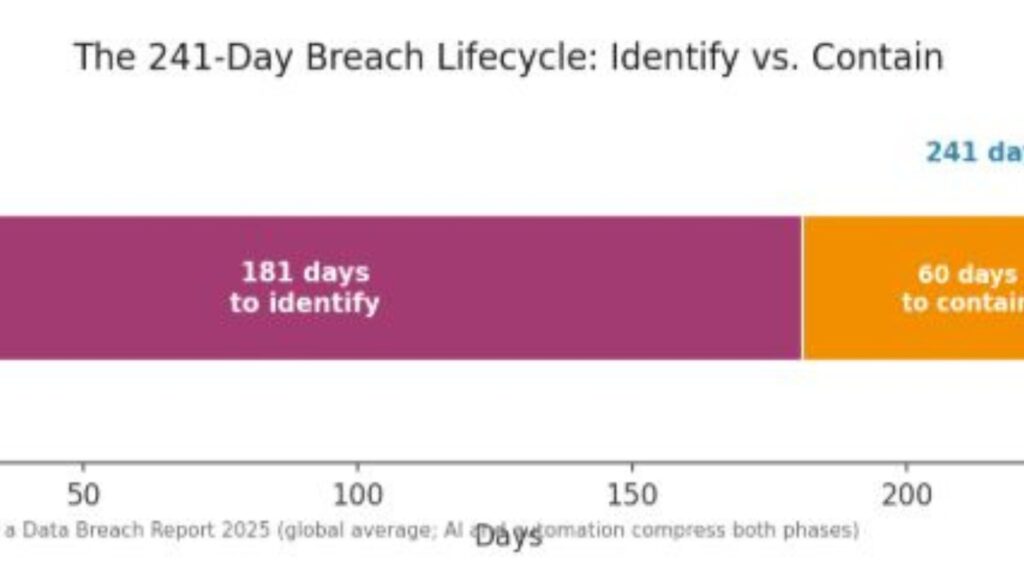
Most of a breach’s life is spent undetected, which is exactly where AI helps.
Adoption is climbing to match. Analysts at Gartner expect half of all threat-detection and response platforms to use agentic AI by 2028, up from fewer than one in ten in 2024.
| Key stat: a 2026 World Economic Forum survey found that 94% of leaders expect AI to be the single biggest driver of change in cybersecurity this year, reshaping both attack and defense. |
“To stay ahead, those of us who defend must use every tool at our disposal, which now includes agentic AI.” Arvind Krishna, IBM
[Video: “AI-Driven Security Orchestration, Automation, and Response (SOAR)”: https://www.youtube.com/watch?v=Is8119OtoD8]
This short lesson explains how AI-driven orchestration automates investigation and response inside the security operations center.
Layered smartly, these tools reinforce rather than replace the layered protection for businesses of every size. None of this is about buying the flashiest platform; the firms seeing real returns treat AI as a capability woven through people and process, and they measure it on outcomes like faster containment rather than on feature lists. Quicker containment is not just cheaper, it also limits the data lost and the trust eroded when an incident drags on.
Keeping Humans in the Loop
For all its speed, AI is not a self-driving operations center. Its output is only as good as the data it learns from, and a confident wrong action can do real damage. Full autonomy is rarely the right design.
| Safe to automate | Keep a human in charge |
|---|---|
| High-volume, known threats | Business-critical system shutdowns |
| Blocking addresses, disabling accounts | Irreversible or destructive actions |
| Alert triage and enrichment | Ambiguous, high-severity calls |
| Warning: attackers use AI too, and poorly tuned automation can block legitimate traffic or miss a cleverly disguised attack. Guardrails, testing, and human review are what keep automation an asset rather than a liability. |
Sensible teams pair automation with fundamentals like strong authentication controls and clear escalation paths, the same discipline that matters when securing a distributed workforce spread across many locations and devices. Done well, this balance turns AI into a genuine advantage. Machines handle the relentless volume and the seconds-matter reactions, while people supply context, ethics, and the final say on anything consequential. The goal is not a security team without humans, but one where humans are freed to do the work only they can.
Frequently Asked Questions
How does AI fit into cyber defense?
AI supports the entire security lifecycle, from detecting threats to investigating, containing, and recovering from them. It analyzes data at a scale humans cannot match and increasingly automates the response.
How does AI speed up incident response?
AI triages and enriches alerts, then runs playbooks that can isolate devices, block traffic, or lock stolen accounts within seconds. That narrows the window between detection and containment, which is the biggest driver of breach cost, and it frees analysts from repetitive first-line work.
What is agentic AI in security?
Agentic AI describes autonomous systems that plan and carry out multi-step response actions on their own, within guardrails. It sits above rule-based automation and AI-assisted tools on the response spectrum.
Can AI fully replace security analysts?
No. AI handles volume and speed, but people must own high-stakes calls such as shutting down critical systems or judging ambiguous alerts. The strongest setups keep humans firmly in the loop.
What should enterprises automate first?
Begin with high-volume, low-risk actions like alert triage, enrichment, and blocking known-bad addresses. Reserve business-critical and irreversible decisions for human approval, and expand as trust grows.
Detection and Response, One Motion
AI’s role in cyber defense has grown from a smarter alarm into a partner that works the whole incident, from the first flicker of an anomaly through to recovery. By compressing the delay between spotting a threat and stopping it, it strikes at the single biggest factor in what a breach ends up costing. The enterprises pulling ahead are not the ones chasing full automation, but the ones that let AI carry the volume and speed while people keep the judgment. Detection and response are merging into one fast, continuous motion, and the defenders who embrace it will stay a step ahead. The threats will keep accelerating, and the response has to accelerate with them. Enterprises that build for that pace now will not be scrambling to catch up later.